Monte Carlo forecasting for Jira teams

Your stakeholders ask "when will it be done?" and your team guesses. Monte Carlo simulation answers that question with data — not estimates.

The idea

What is Monte Carlo forecasting?

Monte Carlo takes the real throughput of your team — how many tickets you actually finished each week — and uses it to simulate thousands of possible futures. The output isn't a single date. It's a probability distribution: 50% chance we're done by May 12, 85% chance by May 28.

The forecast is based on what your team has actually delivered, not on what someone estimated. No story points, no velocity averages — just real throughput data. If the team has been delivering between 4 and 12 tickets per week for the past three months, the simulation samples from that reality.

Why estimates fail

Teams estimate optimistically. Planning Poker produces consensus, not accuracy. And velocity — the go-to metric for most Agile tooling — is an average. Averages hide variance. But variance is exactly what kills deadlines.

A team with velocity 40 and low variance delivers predictably. A team with velocity 40 and high variance delivers somewhere between 20 and 60 any given sprint. The "40" is an illusion; planning around it is planning around a number that almost never actually shows up.

Monte Carlo handles this automatically. It doesn't use the average — it samples from the full distribution of throughput data, including the bad weeks and the great weeks. The variance is built into every simulated future.

How it works

How Cylenivo does it

Cylenivo reads your ticket history from Jira and calculates weekly throughput. Then you can ask it two questions:

No extra configuration beyond the Jira connection. The throughput data comes from the same status transitions that feed cycle time and lead time — if you've set those up, forecasting works out of the box.
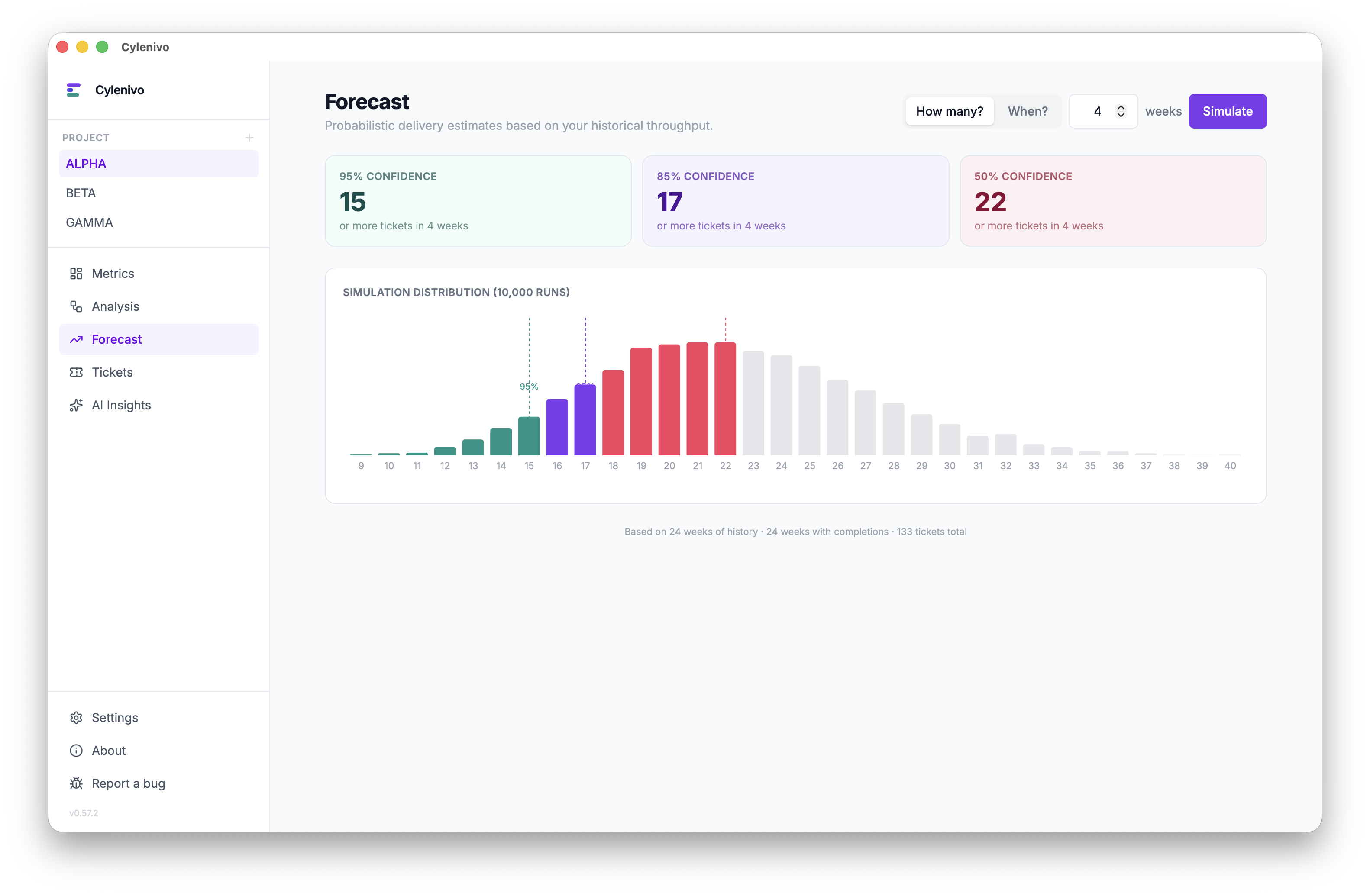
Cylenivo delivery forecast — Monte Carlo simulation with confidence levels

Try it

Connect your Jira instance and run your first forecast in minutes. No estimates needed.

Fetching latest release…

Keep reading

Further reading

Lead time vs cycle time

They're not the same. Learn the difference and why both matter.

Read the guide →

The physics behind flow

Little's Law, Kingman's formula, and why WIP limits aren't optional.

Explore Flow Physics →

The Work-Feedback Loop

A framework for turning metrics into actual change, not just reports.

Read about the WFL →